Journal of Neurology, Neurological Science and Disorders
Evolution of Vascular Neurosurgery in Sub-Saharan Africa
1Neurosurgery, Clinique Ngaliema, Kinshasa, Democratic Republic of the Congo
2Neurosurgery, Universite de Mbujimayi, Mbuji-Mayi, Democratic Republic of the Congo
3Neurosurgery, Universite de Kinshasa, Kinshasa, Democratic Republic of the Congo
4Neurosurgery, Centre Hospitalo-Universitaire du Cinquantenaire, Kinshasa, Democratic Republic of the Congo
5Anesthesiology and Intensive Care, Centre Hospitalo-Universitaire du Cinquantenaire, Kinshasa, Democratic Republic of the Congo
6Neurosurgery, Cadi Ayyad University, Marrakech, Morocco
7Medicine, Autonomous University of Santo Domingo, Santo Domingo, Dominican Republic
8Department of Human Anatomy and Histology, N.V. Sklifosovskiy Institute of Clinical Medicine, I.M. Sechenov First Moscow State Medical University (Sechenov University), Moscow, Russia
Author and article information
Cite this as
Cherubin TM, et al. Evolution of Vascular Neurosurgery in Sub-Saharan Africa. J Neurol Neurol Sci Disord. 2026; 12(1): 1-11. Available from: 10.17352/jnnsd.000065
Copyright License
© 2026 Cherubin TM, et al. This is an open-access article distributed under the terms of the Creative Commons Attribution License, which permits unrestricted use, distribution, and reproduction in any medium, provided the original author and source are credited.Background: Vascular neurosurgical services in sub-Saharan Africa have expanded unevenly. Published technical achievements, treatment access and population coverage are frequently conflated. We mapped recent evidence to distinguish these dimensions of development.
Methods: Europe PMC and targeted publisher and citation searches were undertaken on 29 October 2026 for original journal reports first published between 1 January 2020 and 31 January 2026. A Population Concept Context framework defined eligibility. Patient and lesion denominators, outcome definitions, follow-up and source availability were charted. The evidence and manuscript were reviewed by three human reviewers. Narrative synthesis was used without pooled treatment effects. A supplementary PubMed retrieval was conducted during revision and is reported separately from the original evidence map.
Results: Five database queries returned 623 records and 510 unique records. Thirty-nine database reports and seven additional reports formed the original map: 37 clinical or diagnostic reports and nine capacity or training reports. Full texts were examined for 32 reports; 14 were characterized from original indexed abstracts. Selected centres documented microsurgical service development and established endovascular practice. Delays, financial barriers and uneven institutional resources persisted. Differences in patient selection, outcome definitions and follow-up precluded reliable regional treatment comparisons.
Conclusions: Published reports demonstrate technical feasibility and training activity at selected institutions, but do not establish uniform improvement in regional access, coverage or outcomes. Service development should be assessed through diagnostic access, time to definitive treatment, affordability, complication rescue and complete follow-up. Human review improves verification but does not remove the limitations of the original search coverage or the underlying observational evidence.
Vascular neurosurgery in sub-Saharan Africa is developing within health systems that must provide emergency diagnosis, definitive lesion treatment and sustained postoperative care despite uneven resources. The available literature includes aneurysm clipping, endovascular procedures, vascular malformations, diagnostic studies and training initiatives. These reports describe important local capabilities, but they do not necessarily measure the proportion of people who can obtain treatment when it is needed. Earlier continental reviews identified geographically concentrated evidence and limited reporting of access and outcomes [1,2].
The distinction matters because the operative series begins after several selection events. A patient must survive the initial hemorrhage, recognize the need for care, reach an appropriate facility, obtain vascular imaging and secure funding or authorization. The clinical population arriving in an operating room therefore differs from the population experiencing the disease. A small technically successful series can coexist with substantial untreated need, and a larger hospital caseload can reflect improved detection or referral rather than a change in disease incidence.
Workforce growth provides a second, incomplete measure of development. A continental synthesis documented substantial geographic differences in specialist numbers and training institutions [3]. More recent mapping undertaken with the World Federation of Neurosurgical Societies (WFNS) and other professional organizations further demonstrated international variation in consultant density and resources [4]. Neither general neurosurgeon numbers nor the availability of a microscope identifies how many clinicians can independently manage complex vascular disease with an adequately supported team.
Contemporary aneurysmal subarachnoid hemorrhage (aSAH) guidance emphasizes early definitive management and coordinated specialist care [5]. The question for regional development is consequently broader than whether clipping or coiling can be performed. It concerns whether diagnostic, procedural and rescue services form a reliable pathway, including for patients living far from tertiary centres or unable to finance treatment themselves.
This review maps original evidence first published from January 2020 through January 2026. Its objectives are to characterize documented clinical and technical activity, identify service and training constraints, and distinguish evidence of feasibility from evidence of improved access or outcomes. The review also identifies reporting practices needed for a more reliable account of regional evolution. It does not attempt to reconstruct the entire historical development of African neurosurgery or estimate a comparative treatment effect from unrelated institutional series.
Methods
Review design and reporting
A rapid scoping approach was selected because the question spans clinical cohorts, diagnostic studies, case reports, centre surveys and educational implementation reports. The review was informed by PRISMA-ScR and JBI guidance [6,7]. PRISMA 2020 informed record accounting, and PRISMA-S informed search reporting [8,9]. The protocol was documented during evidence assembly after exploratory searches and was not prospectively registered. This retrospective specification limits assessment of departures from the original review plan. Reporting guidance was used to improve transparency; it does not establish methodological completeness.
Question and eligibility
The Population Concept Context question was: what clinical capability, service access and capacity development relevant to vascular neurosurgery in sub-Saharan Africa are documented in original reports published within the specified interval? Population comprised patients with neurovascular disease and the centres or personnel delivering relevant services. Concept comprised diagnosis, treatment, barriers to definitive care, institutional resources and vascular training. Context was sub-Saharan Africa as defined by the United Nations geographic grouping, including South Africa. Sudan was not treated as sub-Saharan Africa under this definition. Pan-African surveys were retained as contextual capacity evidence when their geographic coverage was explicit; their continental percentages were not relabelled as sub-Saharan estimates.
A complementary PICO question concerned patients with defined neurovascular lesions receiving microsurgical, endovascular or other definitive management, compared with another modality, another time period or no definitive treatment when a valid within-study comparison existed. Outcomes were treatment access and timing, mortality with an explicit time point, functional status, lesion occlusion, complications and follow-up. A comparator was not mandatory for mapping descriptive reports. This prevented the inappropriate exclusion of most available evidence while avoiding an unsupported comparative meta-analysis. Table 1 sets out the operational framework.
Eligible clinical evidence comprised intracranial aneurysms, brain or spinal vascular malformations, traumatic neurovascular lesions and spontaneous hemorrhage reports that directly addressed neurosurgical care or an access barrier. Diagnostic reports were eligible when they concerned recognition or characterization of these lesions. Capacity reports required original information about directly relevant centre resources or vascular education. General neurosurgical commentary without qualifying original data, non-neural vascular lesions, preprints and conference abstracts were not mapped as original journal reports. Noninterventional reports were retained when they documented diagnostic pathways, conservative management or unavailable definitive treatment. Cross-border treatment of a sub-Saharan resident was identified as referral evidence, not domestic procedural capacity.
Dates and information sources
The publication window was 1 January 2020 to 31 January 2026, inclusive; clinical recruitment could precede 2020. First online publication took priority over journal issue year when verified. Thus, publication year was not interpreted as the year of service introduction or patient treatment. An Ivorian report first published in December 2019 was excluded despite its 2020 issue assignment. Background, methodological and molecular-diagnostic references were used as context and were not added to the original regional evidence count.
The original searches were executed on 29 October 2026. Europe PMC was searched through its public application programming interface using geographic and neurovascular terms, centre-capacity terms, hemorrhage-intervention terms and an affiliation field. Five valid outputs were retained. Geographic terms included Africa and named sub-Saharan countries; disease terms included aneurysm, subarachnoid hemorrhage, arteriovenous malformation, cavernous malformation and moyamoya. Exploratory calls using unsupported affiliation labels were excluded from record accounting; the retained affiliation query used AFF.
Targeted publisher searches and backward citation inspection supplemented Europe PMC. Regional sources included African Journal of Neurological Sciences, Annals of African Surgery, Ghana Medical Journal and Health Research in Africa. English and French reports were examined; the database queries imposed no language restriction. Embase, Scopus and Web of Science were not independently searched. PubMed records reached through Europe PMC and PMC full texts were not counted as independent database searches. Targeted web discovery was not treated as an exhaustive regional-journal or Google Scholar search.
During revision, a separate PubMed search was executed through the NCBI E-utilities on 18 November 2026 using geographic, neurovascular and capacity terms and the publication-date interval 1 January 2020 to 31 January 2026. It returned 136 candidate records, all retrieved as bibliographic records. The exact query and search limitations are reported in Supplementary Appendix S1. This supplementary retrieval was not merged with the original 46-report map: reconciliation requires the complete original catalogue, first-online date checks and record-level eligibility decisions. Regional web discovery was not represented as a completed systematic AJOL or African Index Medicus search.
Selection and source verification
Records were deduplicated using normalized DOI, followed by PMID or source identifier. Titles and accessible abstracts were assessed against eligibility, and original full texts were examined when available. Fourteen journal reports were retained at original indexed-abstract level; unavailable methods, follow-up and patient characteristics were not inferred. Clinical and diagnostic reports were charted separately from capacity and training reports. A conference abstract was distinguished from the indexed abstract of a published full journal article: the former was excluded, whereas the latter could support limited descriptive mapping.
The charted evidence and manuscript were reviewed by three human reviewers. This human review is incorporated in the present revision. No inter-rater agreement statistic is reported, and a prospectively specified independent duplicate-screening process is not documented. The authors remain responsible for eligibility decisions, source interpretation and the accuracy of the reported data. Human review does not resolve information absent from the primary publications. No author contact, unpublished dataset retrieval or prospective protocol registration was undertaken.
Data charting and synthesis
Charted items were publication date, recruitment period, geography, study design, patient and lesion denominators, intervention, care intervals, outcome definition, follow-up, source availability and possible overlap. Admitted, investigated, treated and followed populations were kept separate. Functional thresholds such as mRS 0-2 and mRS 0-3 were preserved. Numerical inconsistencies within a primary report were identified rather than repaired by assumption; ambiguous mortality estimates were not used for comparisons. DOI availability was treated as a bibliographic attribute, not evidence of scientific validity or an eligibility requirement.
Narrative synthesis grouped reports into diagnostic access, microsurgical services, endovascular services, other vascular lesions and capacity development. Transparent synthesis without meta-analysis principles were applied where relevant [10]. No pooled mortality, odds ratio, regional patient total or temporal trend test was calculated. Shared institutions, recruitment intervals and subgroup definitions were considered when assessing possible cohort overlap. Heterogeneous case mix, abstract-only information and nonrandom treatment allocation precluded comparative treatment-effect estimation. No formal item-level risk-of-bias assessment or GRADE certainty rating was completed; this limits the assessment of confidence in individual findings.
Workforce interpretation and figures
The ratio of one general neurosurgeon per 100,000 people was considered only as an illustrative general-workforce planning scenario, in the context of specialist workforce literature [4]. It was not used to estimate a vascular-neurosurgeon requirement, an observed deficit or a universal WHO standard. Analytic figures were constructed from explicitly reported counts and a proposed service framework. No reused clinical photograph, angiogram, CT image or anatomical plate is included in the revised manuscript.
Results
Evidence identified
The five Europe PMC queries returned 623 records. After removal of 113 duplicates, 510 unique records were screened; 39 were retained and 471 were not retained. Publisher and citation discovery added seven original reports, giving an original map of 46 reports: 37 clinical or diagnostic reports and nine capacity or vascular-training reports. Full texts were examined for 32 reports and original indexed abstracts for 14. Supplementary Figure S1 summarizes this accounting. These are report counts, not independent patient cohorts. The available counts do not identify separate title-screening, full-text retrieval and full-text-exclusion stages.
Clinical and diagnostic reports documented domestic practice in Cameroon, Ethiopia, Gabon, Ghana, Kenya, Mali, Nigeria, Senegal, South Africa and Tanzania, with an additional cross-border referral narrative. Countries represented in multicountry surveys were not counted as countries with domestic treatment cohorts. The geographic distribution reflects the retrieved literature and must not be read as a map of all existing services. Publication frequency cannot establish changes in operation volume or patient outcomes because recruitment often preceded publication by several years.
Diagnostic access and recognition
The 2021 Pan-African survey included 36 centres in 16 countries. CT angiography was reported at 29 centres, clipping at 22 and endovascular treatment at eight; 23 reported no interventional neuroradiology specialist [11]. These counts describe surveyed African centres, including Northern Africa. The subsequent survey of sub-Saharan training centres reported endovascular availability at 13 of 44 centres and basic clipping training after residency at 18 of 44 [12]. The surveys used different samples, geographic coverage and questions; they are shown separately in Figure 1 and are not a longitudinal comparison.
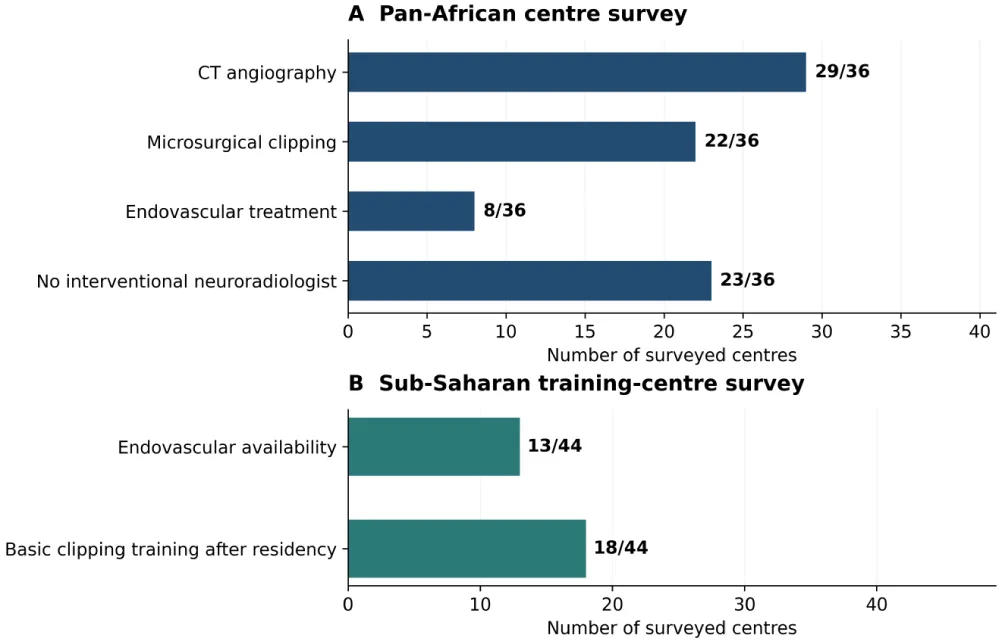
Panel A reports the 2021 Pan-African convenience sample of 36 centres, including Northern Africa [11]. Panel B reports the separate sample of 44 sub-Saharan training centres [12]. Numerators and denominators are shown explicitly; items are not mutually exclusive. Different samples and questions preclude inference about temporal change. Counts describe surveyed centres and not population treatment coverage.
Imaging access did not guarantee diagnostic certainty. In a South African paired study of 115 patients with suspected aSAH, DSA identified aneurysms in 94 patients and CTA identified 75 of those 94 [13]. These patient-level counts must not be substituted for lesion-level diagnostic performance. A Ghanaian DSA cohort recorded 37 aneurysms in 31 referred patients [14], and a Malian cohort described 109 aneurysms in 105 patients [15]. These referral cohorts do not estimate population incidence or natural history. A Nigerian longitudinal report associated changing imaging resources with detected cases, but lacked population-based ascertainment [16].
Microsurgical service development
The literature illustrates several routes to establishing clipping services. In Lagos, Ojo and colleagues reported 45 operated patients with 48 aneurysms; 38 patients survived to discharge [17]. The Ethiopian series included 71 ruptured-aneurysm admissions and 62 operated patients; 52 of the 62 had GOS 4-5 at discharge [18]. Inconsistent mortality figures within that report were not converted into a single estimate. In Senegal, 21 of 34 CTA-confirmed aneurysm patients underwent surgery, and 12 of the 21 had mRS 0-2 at an assessment after at least six months [19]. These observations describe outcomes among selected patients and do not establish regional comparative effectiveness.
A Ghanaian partnership reported six clipping patients treated in 2023 and 2024 [20]. A South African supraorbital series included 17 ruptured aneurysms within a mixed 50-patient population [21]. Its overall functional outcome was not attributed to the aneurysm subgroup. Selected clinical and diagnostic studies are summarized in Table 2, with their source availability and denominator limitations stated explicitly.
A further Nigerian clipping series included 29 operated patients, 19 of whom had experienced preoperative rebleeding [22]. This series illustrates the need to record deterioration before definitive treatment. Its selected operated population cannot quantify the number of patients unable to access care.
Endovascular practice and its limits
South African reports document established endovascular practice at selected institutions. Clarke and colleagues included 77 patients in whom 89 aneurysms were identified and 82 aneurysms were treated endovascularly [23]. These are three different denominators. Harrichandparsad and colleagues reported 445 endovascularly treated aSAH patients during 2012-2021 [24]. The accessible indexed abstract reported mRS 0-3 in 73% at discharge and 82% at long-term assessment. These values were not relabelled mRS 0-2 or converted into patient numerators because follow-up denominators were not supplied. The abstract did not establish a sufficiently explicit time point for its mortality percentage.
A study of oculomotor nerve recovery after coiling analyzed 34 followed patients from a larger posterior communicating artery aneurysm population at the same KwaZulu-Natal institution [25]. This subgroup may overlap the larger institutional series and was not added to it. The Ethiopian report of flow diversion for a supergiant aneurysm documents a more recent technical capability but is a single case [26]. The Kenyan report of endovascular treatment for vein of Galen malformation involved two infants [27]. These publications establish that specific procedures have been performed; they do not show uninterrupted availability, affordable access or population coverage.
Patients outside the definitive treatment pathway
The Tanzanian aSAH series included 22 patients, of whom 14 underwent clipping; the reported median admission-to-treatment interval was 12 days [28]. Four of the 14 clipped patients were treated within the source-defined 72-hour window. The report also described out-of-pocket payment in 13 of 22 patients and a median travel distance of 537 km, providing direct centre-specific information about financial and geographic burden. In Senegal, 46 SAH presentations led to 34 CTA-confirmed aneurysm patients and 21 operations [19]. Of the 13 patients not operated at that centre, five were transferred, two were lost after improvement or refused surgery, and six died preoperatively. Figure 2 preserves these care-pathway denominators. Transfer does not establish absence of subsequent treatment elsewhere, and the groups are not comparable untreated controls.
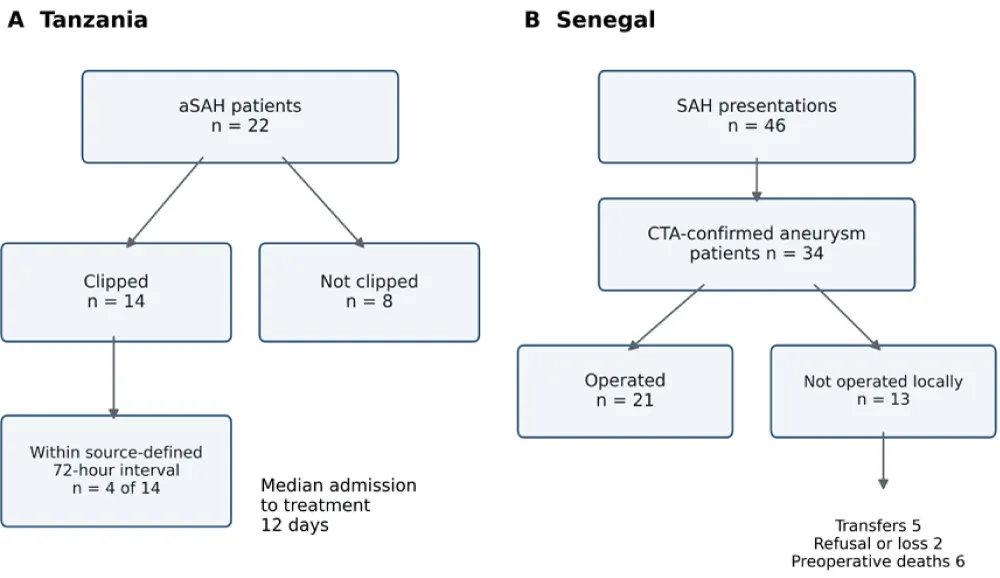
Tanzania data are from the original indexed abstract [28]; Senegal data are from the full report [19]. Patients and lesions are not interchanged. The source-defined Tanzanian 72-hour interval is preserved without assuming its origin matches other reports. Senegalese transfers may have received treatment elsewhere. Non-operated groups are not comparable untreated controls; no causal or between-centre effect is estimated.
The Cameroonian sSAH cohort analyzed 70 records, with in-hospital mortality of 40% and no available definitive surgical or endovascular aneurysm treatment at that centre [29]. Most patients lacked etiological investigation. Its overall sSAH outcomes therefore cannot be presented as outcomes of confirmed aneurysmal hemorrhage. The pediatric Senegal cohort included 24 children, 15 of whom received surgical treatment; its reported attributable-fraction analysis was not interpreted as randomized evidence that a particular number of deaths would have been prevented [30].
Evidence beyond saccular aneurysms
The clinical map also contained brain and spinal AVMs, cavernous malformations, Galen malformations, traumatic vascular lesions and conservative-care pathways. A South African study selected 143 trauma patients for DSA and confirmed vascular injury in 76 [31]. This is diagnostic yield within a selected group, not population incidence. A Ghanaian spinal AVM report explicitly documented unavailable advanced treatment [32]. Case reports can identify diagnostic or referral barriers but provide little basis for estimating regional effectiveness or treatment coverage.
Training and institutional resources
The workforce-to-service gap was visible in several original reports. Among 21 WFNS Rabat Training Centre graduates practicing in 12 sub-Saharan countries, only one third reported access to a microscope [33]. The Ghanaian capacity survey identified 25 consultants and eight trainees across 11 hospitals, with uneven advanced equipment and little neurovascular activity [34]. In Abidjan, an implementation report described a microsurgical skills laboratory with seven table-mounted microscopes and three endoscopes [35]. These are specific survey or institutional observations, not contemporaneous national censuses.
The first EANS vascular and skull base course in East Africa combined lectures, live demonstrations and catheter simulation [36]. A subsequent Pan-African course report first published in January 2026 described increased self-rated vascular knowledge [37]. Its pre-course and post-course survey counts differed, and participant matching was not established from the accessible abstract. These findings describe perceived learning rather than retained technical competence, independent operating ability or improved patient outcomes. An East African infrastructure survey used TBI as a proxy for general service capacity and did not enumerate vascular specialists [38].
Population and workforce context
General neurosurgeon density does not identify the number, distribution or full-time availability of independently competent vascular operators. No consistently defined regional vascular-workforce count was identified. Consequently, no vascular-specialist requirement or shortfall was calculated. Workforce figures require geographic coverage, reference year, professional definition and access to supporting personnel before they can inform service planning.
Discussion
What the evidence shows about evolution
The most defensible account of evolution is an expansion of documented local technical capability and educational activity alongside persistent gaps in access. Clipping programmes, established endovascular cohorts and newer training collaborations are now represented within the same publication interval. The evidence does not support a single trajectory shared across sub-Saharan Africa. Nor does it establish that the region has progressed uniformly from microsurgery to endovascular treatment. Some centres offer multiple approaches, others depend primarily on clipping, and some report no definitive lesion treatment.
Three observations help explain this unevenness. First, vascular practice is highly dependent on the surrounding health system. A trained operator cannot independently resolve the absence of emergency imaging, anesthesia, a critical-care bed or rescue treatment. Second, the existing clinical evidence is concentrated in selected referral institutions and predominantly describes patients who reached specialist care. Third, many papers published after 2020 analyze clinical periods that largely preceded it. Publication growth consequently provides evidence of increased documentation, while the timing of service improvement remains less certain.
Microsurgical capacity remains important
Clipping remains an essential component of the service portfolio described in this literature. The reports from Nigeria, Ethiopia, Senegal and Ghana show that locally based teams and sustained partnerships can establish vascular operations [17-20]. The appropriate interpretation is practical feasibility under specific conditions. These reports should not be used to suggest that a technically demanding procedure becomes safe merely because the alternative is unavailable. Operative capability must include anatomical judgment, proximal control, management of intraoperative rupture, assessment of vessel patency and access to postoperative rescue.
Isolated reports of pericallosal clipping, multiple-aneurysm treatment without adjuncts and a coexisting sellar lesion illustrate the demands of anatomical planning [39-41]. They do not establish equivalent safety with and without intraoperative verification. Adoption of an adjunct requires assessment of the complete operative workflow, independent vessel-patency or occlusion verification and clinical outcomes. Small case reports cannot support a causal claim that an inexpensive adjunct compensates for absent specialist infrastructure.
Endovascular development requires a dependable system
The larger South African cohorts demonstrate that endovascular treatment is an established component of care at selected institutions [23,24]. However, their experience should not be generalized to settings with intermittent access to disposables, limited specialist coverage or uncertain follow-up. Introduction of flow diversion or complex embolization adds dependencies involving stock management, angiography support, medication access and management of thromboembolic or hemorrhagic complications. A single successful case can establish a technical milestone while leaving these broader requirements unresolved [26].
A sustainable programme therefore needs a defined case-selection and referral model rather than an equipment-first expansion plan. The proposed model is complementary: strengthen reliable microsurgical care where it is already deliverable, develop endovascular services where the full supporting pathway is feasible, and maintain referral options for anatomy or complications beyond local capacity. This is an inference from the mapped service constraints, not a comparative economic result. No included cross-centre comparison establishes that one modality is uniformly less costly, more effective or more appropriate across the region.
Diagnostic complexity and emerging molecular approaches
Diagnostic development requires more than scanner availability. In the paired South African study, CTA missed 19 of 94 patients whose aneurysms were identified by DSA; performance was particularly limited for very small and posterior communicating artery aneurysms [13]. These findings support defined escalation and confirmatory-imaging pathways when clinical suspicion persists, while remaining centre-specific performance estimates. Spontaneous SAH should not be relabelled aneurysmal SAH without identification of a causative lesion.
Inherited vascular disorders also require integrated assessment. A central South African study of 16 patients with hereditary haemorrhagic telangiectasia from six families identified pathogenic ENG or ACVRL1 variants in all six probands [42]. Molecular testing involved international collaboration. This family series illustrates clinical and genetic characterization; it does not establish routine regional testing availability or the effectiveness of cerebrovascular treatment.
Emerging research outside sub-Saharan Africa has identified somatic MAP3K3 and PIK3CA variants in cerebral cavernous malformations with genotype-associated imaging characteristics [43]. A proof-of-concept study investigated plasma cell-free DNA and droplet digital PCR for KRAS variants in brain AVMs [44]. Incomplete detection and specialized assay requirements restrict generalization. These approaches concern molecular classification and possible future diagnostic pathways; they do not replace vascular imaging or demonstrate improved access or outcomes in sub-Saharan Africa. These contextual studies were not added to the original 46-report map.
The largest outcome gap may occur before treatment
The literature repeatedly exposes the difference between admitted and operated populations. Tanzania and Senegal each documented patients who did not undergo definitive treatment within the study centre [19,28]. The Cameroonian cohort additionally showed the limitations of a pathway without access to aneurysm securing [29]. Those observations support monitoring the entire care pathway. They do not permit an unadjusted comparison of mortality in treated and untreated patients, because clinical deterioration, severity, affordability and referral decisions influence whether treatment occurs.
Operated-only cohorts omit patients who die before imaging, before transfer or while waiting for intervention. Favorable outcomes among operated survivors can therefore improve without a corresponding improvement in population outcomes. The opposite can also occur: a centre that begins accepting more poor-grade patients may report worse operative outcomes while providing more equitable access. A useful regional registry should distinguish these possibilities by including untreated presentations, documenting reasons for nonintervention and recording the point at which each delay occurred.
The reporting clock deserves particular attention. Time from ictus to first facility, first facility to referral, referral to receiving hospital and receiving admission to lesion securing measure different failures. They cannot be collapsed into a generic time-to-surgery variable. Current aSAH guidance favors treatment as early as feasible, preferably within 24 hours of onset [5]. Descriptions of long delays in historical cohorts should not be rewritten as recommended treatment schedules. Future studies should specify the reference event, time unit, summary statistic and missing-data denominator for every interval.
Lesion recognition should not be confused with natural history
Referral cohorts frequently contain small ruptured aneurysms. Such a finding cannot determine the prospective rupture risk of all small unruptured aneurysms in the population. The denominator of aneurysms that never ruptured is absent, and the size at rupture may not equal the size before rupture. The Ghanaian and Malian anatomical cohorts are valuable descriptions of referred cases, but do not justify a universal lower treatment threshold based on ethnicity or geographic residence [14,15]. Decisions about an unruptured lesion require individualized assessment and appropriate external natural-history evidence.
The same caution applies to claims that aneurysms are intrinsically rare in African populations. Hospital counts depend on recognition, imaging, referral and survival. The Nigerian imaging-linked report documents detection within a changing referral environment [16]. Neither a low count nor an increase after scanner installation independently establishes incidence. Population ascertainment, defined catchments and capture of deaths outside specialist hospitals would be needed to test epidemiological hypotheses. These requirements become even more important for AVMs, cavernous malformations and pediatric lesions, for which the mapped clinical evidence is thinner.
Training outcomes must extend beyond attendance
The Abidjan laboratory and EANS courses provide plausible mechanisms for increasing exposure to microsurgical and catheter skills [35-37]. The next evaluation step is longitudinal: repeated assessment of technical tasks, supervised progression, retention of skills, independent case selection, complication recognition and clinical outcomes. A rise in self-rated knowledge immediately after a course is educationally relevant, but it is not an operative proficiency measure. Unmatched pre-course and post-course groups also limit inference about an individual learning gain.
Partnership effectiveness should consequently be assessed after the visiting team departs. Relevant measures include locally performed cases, continued mentor access, equipment functionality, staff retention, ability to manage complications and continuity of patient follow-up. Local institutions should determine priorities and retain control of data and service development. The Ghanaian partnership and Senegalese mentorship experience offer useful implementation examples, but do not yet provide a controlled estimate of partnership durability or population impact [19,20].
Workforce targets require explicit denominators
A general-workforce ratio of one neurosurgeon per 100,000 people can illustrate planning scale, but it does not specify a vascular-subspecialist requirement [4]. General specialist headcounts, full-time clinical availability and independently competent vascular operators measure different resources. Vascular-service planning also requires anesthesia, neurocritical care, angiography personnel, nursing, equipment maintenance and referral coverage. A national ratio can improve while rural travel times and emergency treatment access remain poor.
Geographic definitions also affect comparisons. All Africa, sub-Saharan Africa and the WHO African Region are different groupings. A published continental workforce estimate that includes Northern Africa must not be divided by the sub-Saharan population, and successive papers with different geographic coverage should not be interpreted as a time series. The continental workforce synthesis and global mapping are useful context [3,4], but neither supplies a verified current vascular specialist count for the review population. Calculating a vascular deficit from those general counts would create false precision.
A reporting agenda that can measure progress
A prospective multicentre reporting system should follow the entire pathway of care. The proposed framework in Figure 3 links recognition and referral, definitive lesion treatment, complication rescue and follow-up. Table 3 sets out a minimum dataset. A consistent denominator is needed at each stage: suspected presentations, confirmed lesions, patients eligible for treatment, treated patients, discharge survivors and patients assessed at follow-up. Institutional treatment fractions should be distinguished from population coverage, which requires an estimate of all people needing care, including those who never reach a study centre.
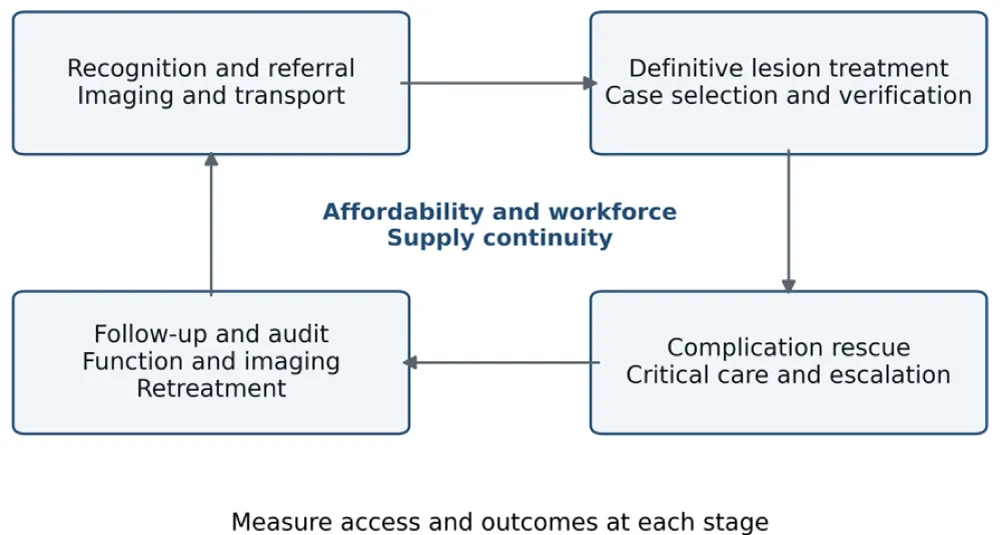
Author synthesis of the mapped evidence and aSAH care domains [5]. The framework links recognition and referral with definitive lesion treatment, complication rescue and follow-up. Affordability, supporting staff and supply continuity affect every stage. This is a proposed reporting framework, not a validated readiness score or evidence of intervention effectiveness.
Clinical outcomes should preserve lesion and timing specificity. For aSAH, clinical grade, hemorrhage burden, hydrocephalus, lesion anatomy, timing and modality should be recorded before outcome comparisons. AVM studies need explicit lesion classification and confirmation of obliteration; spinal vascular reports require their own neurological measures. For all groups, deaths, transfers and follow-up losses should remain visible. Analyses should account for centre clustering and case mix before attributing outcome differences to a technique or to regional development.
A common data dictionary should separate service and clinical questions. The proportion of eligible presenting patients receiving definitive treatment measures institutional treatment completion. Occlusion among treated lesions measures technical performance. Functional recovery among followed patients is a clinical outcome with another denominator. Population access additionally requires catchment-based ascertainment, patients unable to present and the availability and affordability of referral. Patient expenditure, distance and service interruptions deserve prospective recording because an intervention available in principle may remain inaccessible in practice.
Strengths and limitations
The review distinguishes patients from lesions, treated cohorts from admitted populations and full-text evidence from original indexed abstracts. It includes English and French sources and does not exclude reports solely for lacking a DOI. The three-person human review strengthens scrutiny of the charted evidence, but does not establish complete retrieval or remove inconsistencies within primary publications.
The original map relied on one systematically searched bibliographic platform. Targeted publisher and citation searches cannot ensure coverage of regional journals, nonindexed reports or conference-only findings. The supplementary PubMed retrieval improves transparency about additional discoverable records but has not been reconciled with the complete original report catalogue and therefore does not constitute an updated inclusion set. Fourteen mapped reports were assessed only from original indexed abstracts. Human review cannot recover unreported methods, outcomes or follow-up. The findings should therefore be interpreted as a description of the mapped literature rather than an exhaustive estimate of regional provision.
No formal item-level risk-of-bias or comparative certainty assessment was performed. Most clinical evidence is observational and vulnerable to referral selection, missing records, mixed outcome definitions and variable follow-up. Institutional cohorts and subgroups may overlap. Internal source discrepancies were left unresolved rather than repaired by assumption. The unregistered, retrospectively specified protocol limits assessment of selective methodological decisions. Publications after 31 January 2026 were outside the eligibility window even though the search was executed later. Contextual molecular research does not establish implementation or clinical benefit in the review region.
Conclusion
Evidence published from January 2020 through January 2026 documents microsurgical service development, established endovascular practice at selected centres and increasing attention to vascular education in sub-Saharan Africa. It also identifies patients who cannot reach or complete definitive treatment. These selected reports demonstrate local feasibility and specific barriers; they do not establish a uniform regional improvement in access, comparative outcomes or a vascular-workforce deficit. Future evaluations should use lesion-specific definitions, explicit care intervals, reasons for nonintervention, affordability measures, objective assessment of retained competence and complete follow-up. Broader retrieval and a fully traceable report-level catalogue remain necessary for claims of comprehensive regional coverage.
Declarations
Data availability
This review synthesizes published aggregate data and does not create an individual-patient dataset. Supplementary Figure S1 summarizes the original report accounting. Supplementary Appendix S1 documents the supplementary PubMed retrieval undertaken during revision, including its exact query, date and record count. The original source publications remain the basis for study-level findings.
Ethics and images
The review uses published aggregate material and introduces no new patient-level investigation. The revised manuscript contains only analytic figures constructed from reported aggregate counts or an explicitly identified author synthesis. All previously proposed clinical and anatomical illustrations have been removed; no reused patient image or anatomical plate remains, and no image-specific permission or open-licence claim is made.
Human review and accountability
Three human reviewers reviewed the charted evidence and manuscript. The authors are responsible for the accuracy of extracted information, interpretation of source discrepancies, approval of the revised text and compliance with the journal's authorship and disclosure requirements.
- Tetinou F, Kanmounye US, Sadler S, Nitcheu I, Oriaku AJ, Ndajiwo AB, et al. Cerebral aneurysms in Africa: a scoping review. Interdiscip Neurosurg. 2021;26:101291. Available from: https://doi.org/10.1016/j.inat.2021.101291
- Darko K, Simmons G, Elorm Yevudza W, Tenkorang P, Limann B, Agwu C, et al. Presentation, management and outcomes of ruptured intracranial aneurysms in Africa: a systematic review and meta-analysis. J Clin Neurosci. 2025;133:111054. Available from: https://doi.org/10.1016/j.jocn.2025.111054
- Ukachukwu AK, Still MEH, Seas A, von Isenburg M, Fieggen G, Malomo AO, et al. Fulfilling the specialist neurosurgical workforce needs in Africa: a systematic review and projection toward 2030. J Neurosurg. 2023;138(4):1102-1113. Available from: https://doi.org/10.3171/2022.2.JNS211984
- Gupta S, Gal ZT, Athni TS, Calderon C, Callison WÉ, Dada OE, et al. Mapping the global neurosurgery workforce. Part 1: consultant neurosurgeon density. J Neurosurg. 2024;141(1):1-9. Available from: https://doi.org/10.3171/2023.9.JNS231615
- Hoh BL, Ko NU, Amin-Hanjani S, Chou SHY, Cruz-Flores S, Dangayach NS, et al. 2023 guideline for the management of patients with aneurysmal subarachnoid hemorrhage: a guideline from the American Heart Association/American Stroke Association. Stroke. 2023;54(7):e314-e370. Available from: https://doi.org/10.1161/STR.0000000000000436
- Tricco AC, Lillie E, Zarin W, O'Brien KK, Colquhoun H, Levac D, et al. PRISMA extension for scoping reviews (PRISMA-ScR): checklist and explanation. Ann Intern Med. 2018;169(7):467-473. Available from: https://doi.org/10.7326/M18-0850
- Peters MD, Marnie C, Tricco AC, Pollock D, Munn Z, Alexander L, et al. Updated methodological guidance for the conduct of scoping reviews. JBI Evid Synth. 2020;18(10):2119-2126. Available from: https://doi.org/10.11124/JBIES-20-00167
- Page MJ, McKenzie JE, Bossuyt PM, Boutron I, Hoffmann TC, Mulrow CD, et al. The PRISMA 2020 statement: an updated guideline for reporting systematic reviews. BMJ. 2021;372:n71. Available from: https://doi.org/10.1136/bmj.n71
- Rethlefsen ML, Kirtley S, Waffenschmidt S, Ayala AP, Moher D, Page MJ, et al. PRISMA-S: an extension to the PRISMA statement for reporting literature searches in systematic reviews. Syst Rev. 2021;10(1):39. Available from: https://doi.org/10.1186/s13643-020-01542-z
- Campbell M, McKenzie JE, Sowden A, Katikireddi SV, Brennan SE, Ellis S, et al. Synthesis without meta-analysis (SWiM) in systematic reviews: reporting guideline. BMJ. 2020;368:l6890. Available from:https://doi.org/10.1136/bmj.l6890
- Dokponou YCH, Kotecha J, Bandyopadhyay S, Erhabor J, Ooi SZY, Egiz A, et al. Continental survey of access to diagnostic tools and endovascular management of aneurysmal subarachnoid hemorrhage in Africa. Front Surg. 2021;8:690714. Available from: https://doi.org/10.3389/fsurg.2021.690714
- Dokponou YCH, Alihonou T, Adjiou DKFP, Obame FLO, Nyalundja AD, Dossou MW, et al. Surgical aneurysm repair of aneurysmal subarachnoid hemorrhage in sub-Saharan Africa: the state of training and management. World Neurosurg. 2023;176:e485-e492. Available from: https://doi.org/10.1016/j.wneu.2023.05.085
- Mkhize NN, Mngomezulu V, Buthelezi TE. Accuracy of CT angiography for detecting ruptured intracranial aneurysms. S Afr J Radiol. 2023;27(1):a2636. Available from: https://doi.org/10.4102/sajr.v27i1.2636
- Sarkodie BD, Jimah BB, Mohammed AH, Akpalu A, Brakohiapa EK, Anim D, et al. Intracranial aneurysms in Ghanaian adults. Ghana Med J. 2023;57(3):250-255. Available from:https://doi.org/10.4314/gmj.v57i3.13
- Dama M, Coulibaly O, Diallo O, Sissoko D, Diarra H, Tembine K, et al. Angiographic features of intracranial aneurysms in Mali: a preliminary study of 105 patients. World J Neurosci. 2023;13(1):1-11. Available from:https://doi.org/10.4236/wjns.2023.131001
- Ohaegbulam SC, Ndubuisi CA, Okwuoma O, Mezue W, Ajare EC, Oti B, et al. Will improved neuroradiology facilities debunk the reported rarity of intracranial aneurysms in sub-Saharan Africa? Surg Neurol Int. 2023;14:113. Available from:https://doi.org/10.25259/SNI_136_2023
- Ojo OA, Bankole OB, Onyia CU, Awofeso O, Dawang Y. Surgical management of aneurysmal subarachnoid haemorrhage in a resource-constrained region: a Nigerian regional experience. Brain Spine. 2023;3:101778. Available from:https://doi.org/10.1016/j.bas.2023.101778
- Biluts Mersha H, Bogale Megerssa T. Microsurgical treatment of ruptured intracranial aneurysms: an Ethiopian experience. World Neurosurg X. 2024;23:100363. Available from: https://doi.org/10.1016/j.wnsx.2024.100363
- Diop S, Thioub M, Diallo S, Tine I, Basse AS, Wague D, et al. Installation of a vascular neurosurgery activity based on the clipping of ruptured intracranial aneurysms at the Senegal army training hospital: preliminary study. Egypt J Neurosurg. 2025;40(1):127. Available from: https://doi.org/10.1186/s41984-025-00471-0
- Totimeh T, Adjei Osei EK, Kweidjartey I, Darko K, Buckman V, Kanmounye US, et al. Developing aneurysm clipping capacity in Ghana through global neurosurgical collaboration: a case series from two global brainsurgery initiative mission trips. J Clin Neurosci. 2025;141:111607. Available from: https://doi.org/10.1016/j.jocn.2025.111607
- Ndlovu B, Sattar MOA, Mkhaliphi MM, Leola K, Mpanza MN, Ouma JR, et al. Supraorbital eyebrow approach: a single-center experience. Surg Neurol Int. 2022;13:566. Available from:https://doi.org/10.25259/SNI_810_2022
- Idowu JO, Idowu O, Oyeleke SO. Outcome of cerebral aneurysm clipping in Nigeria: a single-centre experience. Niger Med J. 2022;63(4):312-320. Available from:https://doi.org/10.60787/nmj.v63i4.75
- Clarke H, Nefale T, Mngomezulu V. Endovascular management of intracranial aneurysms at Chris Hani Baragwanath Academic Hospital. S Afr J Radiol. 2023;27(1):a2634. Available from: https://doi.org/10.4102/sajr.v27i1.2634
- Harrichandparsad R, Bhigjee AI, Royston D, Olivier S. Endovascular management and long-term outcomes of aneurysmal subarachnoid hemorrhage among a large cohort of patients managed at a specialist hospital in KwaZulu-Natal, South Africa from 2012 to 2021. World Neurosurg. 2025;202:124386. Available from:https://doi.org/10.1016/j.wneu.2025.124386
- Abdurahman E, Amod K, Royston D, Harrichandparsad R. Recovery of oculomotor nerve palsy after endovascular management of posterior communicating artery aneurysms. S Afr J Radiol. 2020;24(1):a1887. Available from:https://doi.org/10.4102/sajr.v24i1.1887
- Tekle WG, Belayneh EK, Eticha KT, Soboka TA, Teka MY, Mengistu HA, et al. First endovascular flow diversion treatment for a supergiant brain aneurysm (>110 mm) in Ethiopia. Stroke Vasc Interv Neurol. 2025;5(3):e001610. Available from:https://doi.org/10.1161/SVIN.124.001610
- Mogere E, Munguti C. Endovascular treatment of vein of Galen malformation in Kenya, East Africa. Ann Afr Surg. 2022;19(3):153-157. Available from: https://doi.org/10.4314/aas.v19i3.4
- Waterkeyn F, Lohkamp LN, Ikwuegbuenyi CA, Mchome LL, Rutabasibwa NB, Shabani HK, et al. Current treatment management of aneurysmal subarachnoid hemorrhage with prevailing trends and results in Tanzania: a single-center experience at Muhimbili Orthopedic and Neurosurgery Institute. World Neurosurg. 2023;170:e256-e263. Available from:https://doi.org/10.1016/j.wneu.2022.11.003
- Gams Massi D, Pazeu MD, Motah M, Magnerou AM, Kenmegne C, Mbahé S, et al. Spontaneous subarachnoid hemorrhage in a referral health centre in Central Africa. eNeurologicalSci. 2024;36:100518. Available from:https://doi.org/10.1016/j.ensci.2024.100518
- Thioub M, Mbaye M, Zolo Y, Sghiouar M, Diop S, Wague D, et al. The burden of pediatric subarachnoid hemorrhage healthcare disparities in Senegal: a retrospective cohort study. Pediatr Neurosurg. 2022;57(2):78-84. Available from:https://doi.org/10.1159/000521450
- Omotoso BR, Harrichandparsad R, Lazarus L. The spectrum of vascular injuries secondary to traumatic brain injury: a single-center study based on digital subtraction angiography. World Neurosurg. 2025;199:124108. Available from: https://doi.org/10.1016/j.wneu.2025.124108
- Boakye FN, Vowotor RK, Awoonor-Williams R, Baidoo PK, Bandoh D, Abdullah HD. Spinal arteriovenous malformation. J West Afr Coll Surg. 2022;12(1):88-90. Available from: https://doi.org/10.4103/jwas.jwas_80_22
- Karekezi C, El Khamlichi A, El Ouahabi A, El Abbadi N, Ahokpossi SA, Ahanogbe KMH, et al. The impact of African-trained neurosurgeons on sub-Saharan Africa. Neurosurg Focus. 2020;48(3):E4. Available from: https://doi.org/10.3171/2019.12.FOCUS19853
- Abu-Bonsrah N, Totimeh T, Kanmounye US, Banson M, Bandoh D, Sarpong K, et al. Assessment of the neurosurgical capacity in Ghana: challenges and opportunities. World Neurosurg. 2022;167:e953-e961. Available from: https://doi.org/10.1016/j.wneu.2022.08.120
- Konan ML, Diaby R, Ghomsi NC, Meuga WM, Djondé G, Brou J, et al. Establishing the first neurosurgical skill laboratory in West Africa: an initiative for an affordable regional education center. World Neurosurg X. 2022;15:100122. Available from: https://doi.org/10.1016/j.wnsx.2022.100122
- Cadieux M, Demetriades AK, Rasulic L, Rutabasibwa N, Kinghomella A, Kaale A, et al. The first EANS vascular and skull base hands-on course in East Africa: review from the global and humanitarian neurosurgical committee initiative. Brain Spine. 2025;5:104210. Available from: https://doi.org/10.1016/j.bas.2025.104210
- Petr O, Preuss-Hernández C, Rutabasibwa NB, Garvayo M, Sabas R, Demetriades AK, et al. Crossing boundaries in neurosurgical education: the Pan-African EANS-supported course as a blueprint for global capacity building. Brain Spine. 2026;6:105930. https://doi.org/10.1016/j.bas.2026.105930
- Ukachukwu AK, Seas A, Brtek V, Cheserem B, Karekezi C, Shitsama SV, et al. Assessment of neurosurgical workforce, infrastructure, and service delivery capacity in East Africa: a collaborative survey. Neurosurg Rev. 2026;49(1):30. Available from: https://doi.org/10.1007/s10143-025-03930-2
- Badejo OA, Adeolu AA. Pericallosal artery aneurysm: case report, literature review and management outcome. Int J Surg Case Rep. 2020;68:32-35. Available from: https://doi.org/10.1016/j.ijscr.2020.02.022
- Onyia CU, Ojo OA. Strategies for treatment of multiple brain aneurysms without intraoperative adjuncts. World Neurosurg. 2022;166:54-59. Available from: https://doi.org/10.1016/j.wneu.2022.07.050
- Onyia C, Ojo O, Arekhandia B. Sellar brain tumour co-existing with a left posterior communicating aneurysm causing ptosis: lessons learnt (case report). Pan Afr Med J. 2023;44:60. Available from: https://doi.org/10.11604/pamj.2023.44.60.38596
- Mutize TT, Seedat RY, Ploos van Amstel JK, Mager JJ, Brown SC, Gebremariam F, et al. The clinical and genetic features of hereditary haemorrhagic telangiectasia (HHT) in central South Africa—three novel pathogenic variants. Mol Biol Rep. 2020;47(12):9967-9972. Available from: https://doi.org/10.1007/s11033-020-05985-4
- Weng J, Yang Y, Song D, Huo R, Li H, Chen Y, et al. Somatic MAP3K3 mutation defines a subclass of cerebral cavernous malformation. Am J Hum Genet. 2021;108(5):942-950. Available from: https://doi.org/10.1016/j.ajhg.2021.04.005
- Zhang M, Zhao S, Yu L, Li X, Hu S, Wang C, et al. Utility of circulating plasma cell-free DNA for detection and quantification of brain arteriovenous malformations. Nano Today. 2024;58:102440. Available from: https://doi.org/10.1016/j.nantod.2024.102440



 Save to Mendeley
Article Alerts
Subscribe to our articles alerts and stay tuned.
 This work is licensed under a Creative Commons Attribution 4.0 International License.