Annals of Psychiatry and Treatment
AI-Augmented Care for Non-Suicidal Self-Injury: Early Detection of Physiological Activation, Graph-Based Coping Paths, and Just-in-Time GenAI Support
1Top Health Tech (Top Doctors Group), Barcelona, Spain
2Departament de Projectes i Construcció, Universitat Politècnica de Catalunya, Barcelona, Spain
Author and article information
Cite this as
Cusidó J. AI-Augmented Care for Non-Suicidal Self-Injury: Early Detection of Physiological Activation, Graph-Based Coping Paths, and Just-in-Time GenAI Support. Ann Psychiatry Treatm. 2026; 10(1): 48-51. Available from: 10.17352/apt.000075
Copyright License
© 2026 Cusidó J. This is an open-access article distributed under the terms of the Creative Commons Attribution License, which permits unrestricted use, distribution, and reproduction in any medium, provided the original author and source are credited.Non-suicidal self-injury (NSSI) represents an escalating public health challenge, particularly among adolescents and young adults, rooted fundamentally in acute emotion dysregulation [1].
Non-suicidal self-injury (NSSI) represents an escalating public health challenge, particularly among adolescents and young adults, rooted fundamentally in acute emotion dysregulation [1]. Meta-analytic findings confirm that deficits in distress tolerance and heightened affective intensity precede self-harm acts across clinical settings [1]. While traditional clinical interventions, such as Dialectical Behavior Therapy (DBT), provide the gold standard for distress tolerance, their real-world efficacy is often challenged by the “ecological gap”—the critical temporal disconnect between weekly outpatient visits and acute moments of emotional vulnerability in daily life.
Here, we present an interdisciplinary, closed-loop AI-Augmented Psychiatric Framework designed to bridge this ecological gap while reinforcing the central role of clinicians. The platform synergizes real-time Ecological Momentary Assessment (EMA), multi-stage Machine Learning (ML) risk phenotyping, graph-based therapeutic recommendation engines, and context-aware Generative AI (GenAI) agents to deliver Just-In-Time Adaptive Interventions (JITAI) [2–6].
Theoretical framework & coping graph
In this framework, several concepts are used in a specific clinical sense. Emotional dysregulation refers to difficulty recognizing, tolerating, and modulating intense emotional states, whereas physiological arousal represents the bodily activation that may accompany an escalating emotional response. The term “urge build-up” refers to the period in which emotional and physiological activation increasingly narrows the individual’s available coping options and may increase vulnerability to NSSI. NSSI is therefore treated not simply as an isolated behavior, but as the endpoint of a dynamic process in which changes in affect, arousal, coping capacity, and situational context may occur over time. This distinction is important because the proposed AI system is intended to support intervention during earlier stages of this process, particularly physiological arousal and urge escalation, rather than attempting to treat the self-injurious behavior itself. In this way, the framework complements established approaches such as DBT by extending selected distress-tolerance and emotion-regulation strategies into the periods between clinical encounters.
Our architecture operationalizes the empirical dysregulation trajectory (Figure 1):

Operationalizing this requires frequent, brief emotion sampling (EMA) and, where available, passive ‘digital phenotyping’ signals from smartphones or wearables. Recent reviews suggest that passive sensing can improve short‑term prediction of suicidal and self‑harm risk, complementing active mood inputs [7–9].
Recent developments in digital mental health further support the potential of AI-assisted monitoring when it is embedded within clinically informed care pathways. Machine-learning approaches can identify patterns across repeated emotional and behavioral observations that may be difficult to recognize through isolated clinical encounters, while digital phenotyping and passive sensing provide additional opportunities to capture changes occurring in everyday settings [2,7–9]. At the same time, evidence from studies of conversational mental-health agents suggests that AI-supported interventions may improve engagement and provide accessible, timely support for selected psychological symptoms [3–5]. These findings provide an important foundation for the present framework, while also emphasizing that predictive performance alone is not sufficient for clinical implementation. AI outputs need to be translated into understandable, proportionate, and clinically supervised actions that remain consistent with established therapeutic approaches.
To address each level of arousal, interventions are organized along a 4-phase DBT continuum:
- Phase 1 (Crisis Arrest & Sensory Shift): Immediate physiological de-escalation (e.g., 4-4-6 diaphragmatic breathing, mammalian dive reflex via cold water exposure, sensory grounding).
- Phase 2 (Physiological & Dopaminergic Discharge): Motor displacement for severe anger and agitation (e.g., high-intensity interval training, heavy-bag boxing).
- Phase 3 (Mastery & Cognitive Flow): Attentional redirection through structured creative engagement (e.g., expressive drawing, writing, musical absorption).
- Phase 4 (Vital Values & Autonomous Self-Efficacy): Value-driven behavioral consolidation and interpersonal connectivity (e.g., social outreach, shared routines).
To ensure personalized matching, strategies are modeled as a Multi-Dimensional Coping Graph (G = (V, E)), where each node represents a validated DBT technique characterized across Physical Intensity (Ip), Introspective Depth (Id), and Social Component (Sc). Distance metric calculations dynamically generate similarity-ranked alternatives (“More like this”), offering clinically isomorphic substitutions tailored to patient preferences (Figures 2,3).
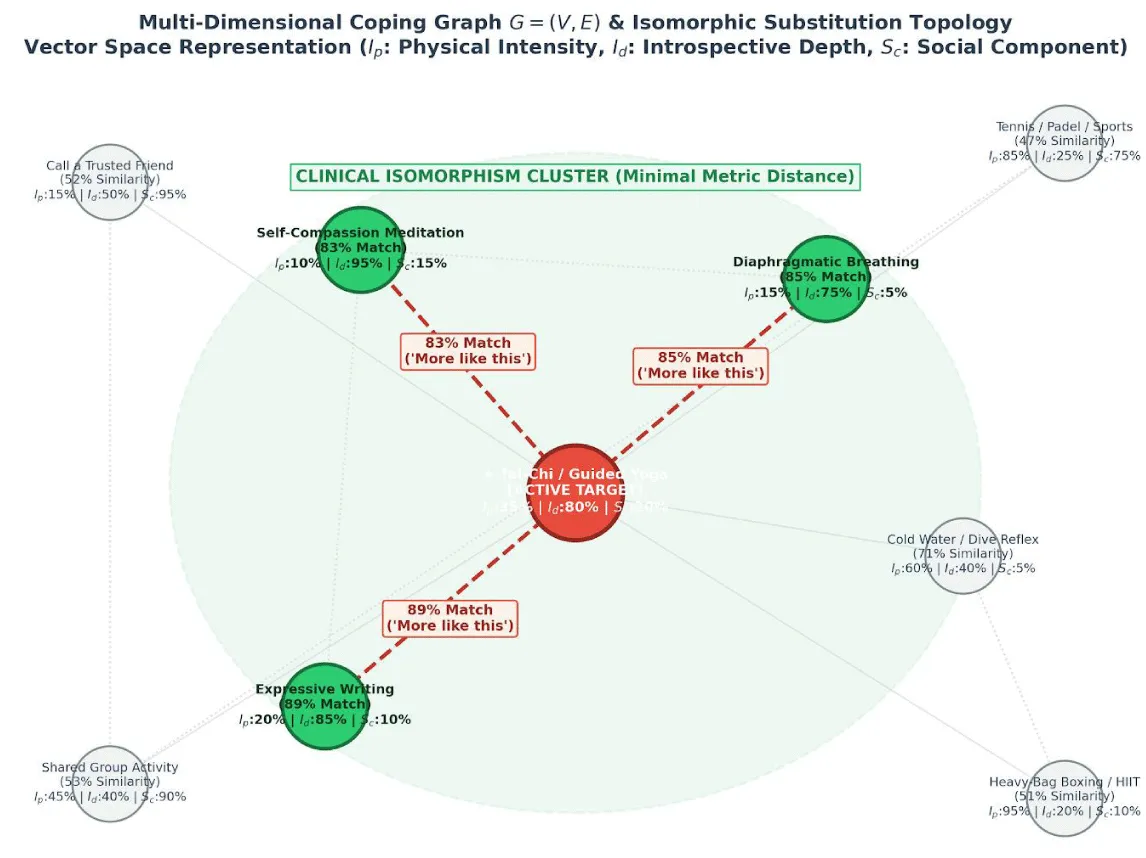
Multi-Dimensional Coping Graph (G = (V, E)) and Isomorphic Substitution Topology for Dialectical Behaviour Therapy (DBT).
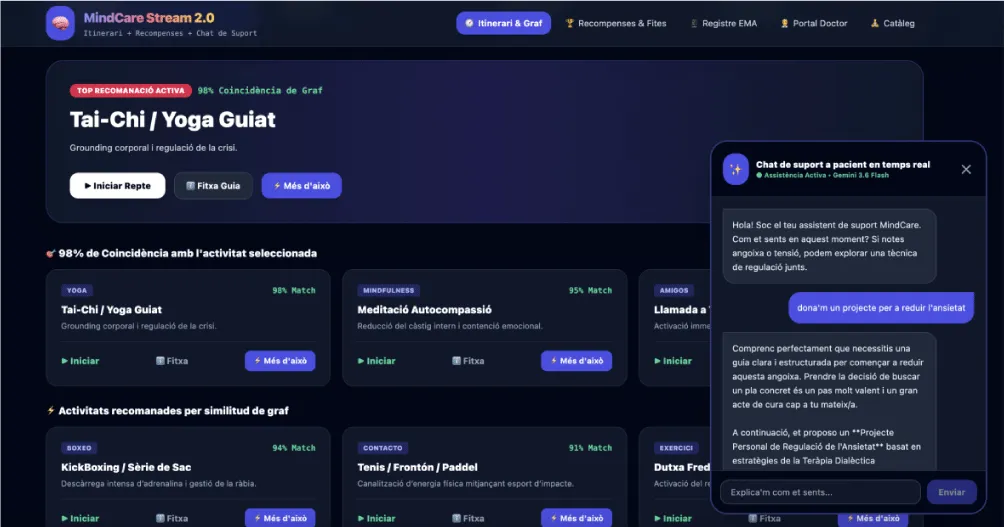
AI for early detection from emotion data
Machine‑learning classification of EMA features has demonstrated feasibility for forecasting NSSI risk in near‑real‑time. For example, a study in young adults trained models on eight emotion dimensions and predicted NSSI with clinically meaningful accuracy [2]. In our internal development work, a gradient‑boosting classifier trained on 2,135 emotion‑tagged records from 64 individuals prioritized sensitivity and achieved high out‑of‑sample detection of imminent self‑harm risk; this supports using probabilistic thresholds (e.g., ≥40%) to trigger preventative action [10,11].
Rather than relying on static heuristic rules, the system employs a multi-model architecture:
- Supervised Risk Prediction (XGBoost): Evaluates multidimensional EMA affective inputs (sadness, anguish, guilt, anger, frustration, shame, happiness, relaxation) to predict imminent self-harm probability (P(NSSI)) [2,10].
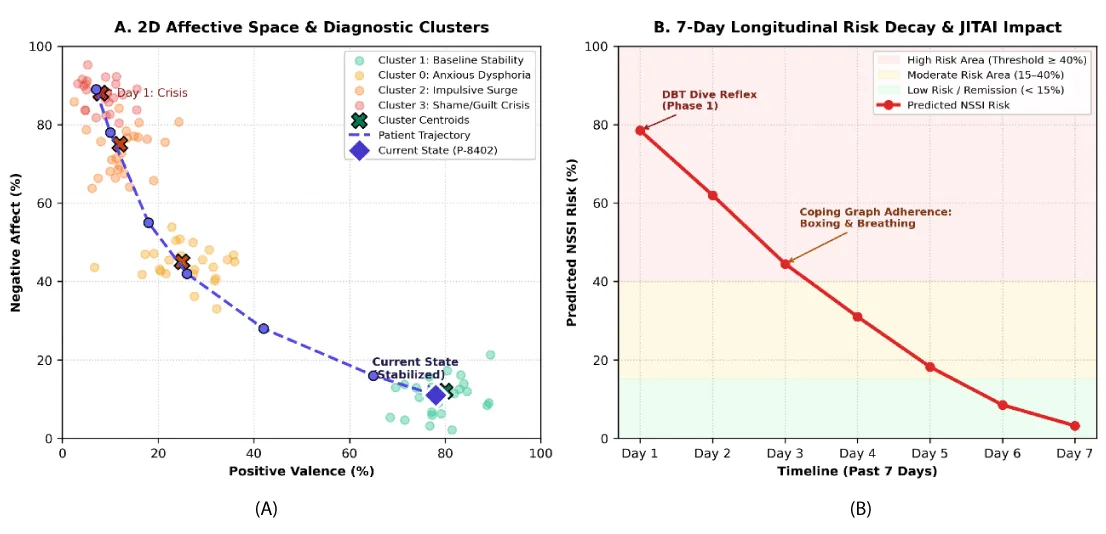
- Affective Clustering (K-Means): Discretizes real-time emotional states into 4 clinical phenotypes: Cluster 0 (Anxious Dysphoria), Cluster 1 (Baseline Stability), Cluster 2 (Impulsive/Anger Surge), and Cluster 3 (High-Risk Guilt/Shame Crisis).
- Anomaly Detection: Identifies acute affective departures against the individual’s baseline emotional trajectory (Contamination = 0.05).
Validation in our exploratory cohort (N = 64 individuals, 2,135 longitudinal EMA records) confirmed that combining multi-emotion weighting with gradient boosting achieves high sensitivity in identifying imminent risk transitions [10], supporting probabilistic triaging for timely intervention.
GenAI to offer safer alternatives and close the loop
Detection must be paired with intervention. Conversational agents can translate a high‑risk alert into personalized coping prompts—e.g., a 2‑minute guided breathing exercise, a prompt to contact a trusted person, or a brief activity challenge—aligned with distress‑tolerance skills. Recent randomized and controlled studies indicate that mental‑health chatbots can reduce anxiety and depressive symptoms and sustain engagement [3–6]. We implement a closed‑loop recommendation system: after a suggestion is delivered, the user provides quick feedback (thumbs up/down) and a brief post‑emotion rating; weights in the decision tree update so that strategies with demonstrated benefit (e.g., mindfulness vs. social vs. physical activity) are preferentially offered next time [11].
When elevated risk is detected, a conversational LLM agent (optimized for low-latency clinical interaction) translates real-time risk scores, active emotional clusters, and recent user trajectory into personalized, empathetic coping prompts.
Crucially, AI does not replace clinical judgment or human psychotherapy. The non-substitutable domain of this digital agent is strictly defined as in-the-moment ecological scaffolding and auto-efficacy restoration:
- Deterministic Emergency Guardrails: A pre-LLM firewall continuously parses inputs for acute suicidal intent or self-harm keywords (e.g., “suïcidi”, “matar-me”, “autolesió”). Detection immediately bypasses automated chatting and activates institutional emergency protocols (061 Salut Respon, 024 Suicide Line, 112).
- Gamification of Self-Efficacy: Completing coping activities awards progress badges, maintains continuity streaks, and increments an internal Self-Confidence Score (∆Auto-efficacy +10%), reinforcing internal locus of control rather than digital dependency.
Clinician triaging portal: Ecological synchrony
To preserve and enhance standard therapeutic relationships, patient interactions feed directly into a Clinician Triaging Portal. Psychiatrists and psychologists access 2D spatial scatter plots mapping patient trajectories across Positive Valence (X-axis) versus Negative Affect (Y-axis) relative to diagnostic cluster centroids, alongside 7-day longitudinal risk trends. This enables clinicians to objectively evaluate real-world strategy adherence, identify specific DBT coping failures between visits, and personalize subsequent in-person psychotherapy (Figure 4).
From a broader international perspective, the proposed approach is consistent with the wider movement toward digitally supported, measurement-informed mental-health care. Although models of mental-health service delivery differ across countries and health systems, digital interventions increasingly aim to extend support beyond traditional face-to-face encounters through mobile assessment, remote monitoring, and adaptive interventions [6,7,12]. The present framework builds on this direction while retaining a clinician-supervised model: technology is used to collect ecological information, identify changes in risk or emotional state, and provide immediate coping support, whereas assessment, clinical interpretation, treatment planning, and escalation remain within the professional care pathway. This distinction is particularly relevant for NSSI, where the timing and context of emotional escalation may not coincide with scheduled clinical appointments. Thus, the proposed model should be viewed as an adaptable digital layer that can complement different forms of established mental-health care rather than as a replacement for any particular national or therapeutic model.
Clinical integration and safeguards
The AI–GenAI workflow is designed to be clinician‑supervised and augmentative. Threshold breaches can notify care teams per protocol; crisis pathways supersede automated nudges. Data minimization, transparency of model behavior, audit trails, and bias monitoring are essential for safe deployment. The interdisciplinary nature of this framework is central to its potential clinical value. From an artificial-intelligence perspective, machine-learning models provide mechanisms for identifying patterns in longitudinal emotional data and supporting individualized risk stratification [2,10]. From a psychiatric and behavioral perspective, the intervention is grounded in emotion regulation, distress tolerance, NSSI risk processes, and DBT-based coping strategies [1, 13]. From a digital mental-health perspective, EMA, passive sensing, conversational agents, and Just-In-Time Adaptive Interventions provide mechanisms for delivering support in the contexts in which symptoms and urges actually occur [3-9,12]. Finally, from a public-health perspective, the approach addresses the need to extend preventive support beyond episodic clinical encounters while maintaining appropriate safeguards, human oversight, and pathways for escalation. Bringing these perspectives together is important because effective AI-supported NSSI care cannot be evaluated solely on model accuracy; it also requires consideration of clinical usefulness, behavioral relevance, safety, acceptability, equity, and integration with existing services. We propose evaluating the system as an adjunct to standard care, measuring reductions in NSSI frequency, improvements in emotion‑regulation skill use, and user/clinician acceptability.
Acknowledgements
This work was supported by the Spanish Ministry of Digital Transformation and Public Policies, on the project OptiSalud TSI-100123-2024-31 – Optimization del tempos de spear y visit de patients’ en clinics privates mediate compartición de dates.
- Wolff JC, Thompson E, Thomas SA, et al. Emotion dysregulation and non-suicidal self-injury: a meta-analytic review. Eur Psychiatry. 2019;59:25-36. Available from: https://doi.org/10.1016/j.eurpsy.2019.03.004
- Martí-Puig P, Capra C, Vega D, Llunas L, Solé-Casals J. A machine learning approach for predicting non-suicidal self-injury in young adults. Sensors (Basel). 2022;22(13):4790. Available from: https://doi.org/10.3390/s22134790
- Li H, Lee D, Xiong S, et al. Effectiveness of AI-based conversational agents on mental health: systematic review and meta-analysis. NPJ Digit Med. 2023;6:92. Available from: Li H, Lee D, Xiong S, et al. Effectiveness of AI-based conversational agents on mental health: systematic review and meta-analysis. NPJ Digit Med. 2023;6:92.
- Karkosz S, Czabanowska K, Khan N, et al. Effectiveness of a web-based and mobile therapy chatbot (Woebot): randomized controlled trial. J Med Internet Res. 2024;26:e10993129. Available from: https://doi.org/10.2196/47960
- MacNeill AL, Weatherley CM, Gonzalez A, et al. Effectiveness of a mental health chatbot (Wysa) in adults: randomized controlled study. Lancet Digit Health. 2024;6(8):e560-e572. Available from: https://doi.org/10.2196/50025
- Torous J, Andersson G, Bertagnoli A, et al. Towards a consensus around standards for smartphone apps and digital mental health. World Psychiatry. 2019;18(1):97-98. Available from: https://doi.org/10.1002/wps.20592
- Büscher R, Harari GM, Reininghaus U, et al. Passive sensing for prediction of suicidal thoughts and behaviors: a systematic review. NPJ Ment Health Res. 2024;3:89.
- Ahn CY, Kim S, Park SH, et al. Digital phenotyping for real-time monitoring/prediction of non-suicidal self-injury: protocol. J Med Internet Res. 2024;26:e10884894.
- Winstone L, Zucchelli E, Brookes A, et al. Ecological momentary assessment of self-harm thoughts and behaviors: protocol and considerations. JMIR Ment Health. 2024;11:e63132. Available from: https://doi.org/10.2196/63132
- Laouar S. Preventing a new episode of non-suicidal self-harm: internship report (2022-2023). University of Vic-Central University of Catalonia; 2023.
- Capra C, Soler J, Vega D, et al. Método para el seguimiento y tratamiento de pacientes de salud mental. Spanish patent-pending method. 2023.
- Nahum-Shani I, Smith SN, Spring BJ, et al. Just-in-time adaptive interventions (JITAIs) in mobile health: key components and design principles for ongoing health behavior support. Ann Behav Med. 2018;52(6):446-462. Available from: https://doi.org/10.1007/s12160-016-9830-8
- Linehan MM. DBT skills training manual. 2nd ed. New York: Guilford Press; 2014.


 Save to Mendeley
Article Alerts
Subscribe to our articles alerts and stay tuned.
 This work is licensed under a Creative Commons Attribution 4.0 International License.